Core primitives of the brModel
Methodology → building blocks
The smallest objects that make memory auditable.
A durable memory system must represent reality in a way that survives model churn. That means: the unit of memory is not “a paragraph” — it is a structured object with provenance.
What we treat as first-class
Subjects (actors)
Who acts in the domain: people, teams, organizations, services, devices. Subjects have capacity and can initiate processes and decisions.
Objects (things acted on)
What is produced, consumed, owned, transferred, or constrained: contracts, assets, claims, datasets, molecules, configurations. Objects carry “what changes hands”.
Processes (events/transformations)
What happens over time: treatments, approvals, payments, failures, audits, experiments. They explain how the state of entities changes.
Relations
How things are connected in reality: agreements, authorizations, obligations, dependencies, contraindications, violations, explanations, causal links. Relations are queryable and auditable.
Sources (provenance objects)
Where we learned it: document IDs, versions, timestamps, authors, datasets, and extraction method. Provenance turns memory into evidence.
Interactions (meta-ontology)
Every domain model reduces to two reusable interaction families: Edge – Influence (one thing affects another) and Edge – Inheritance (one thing specializes another).
The meta-ontology (why this is interdisciplinary)
We separate “what exists” from “how it interacts”.
The same abstract building blocks work in biotech, finance, cybersecurity, and law because they describe structure, change, and evidence — not a specific discipline.
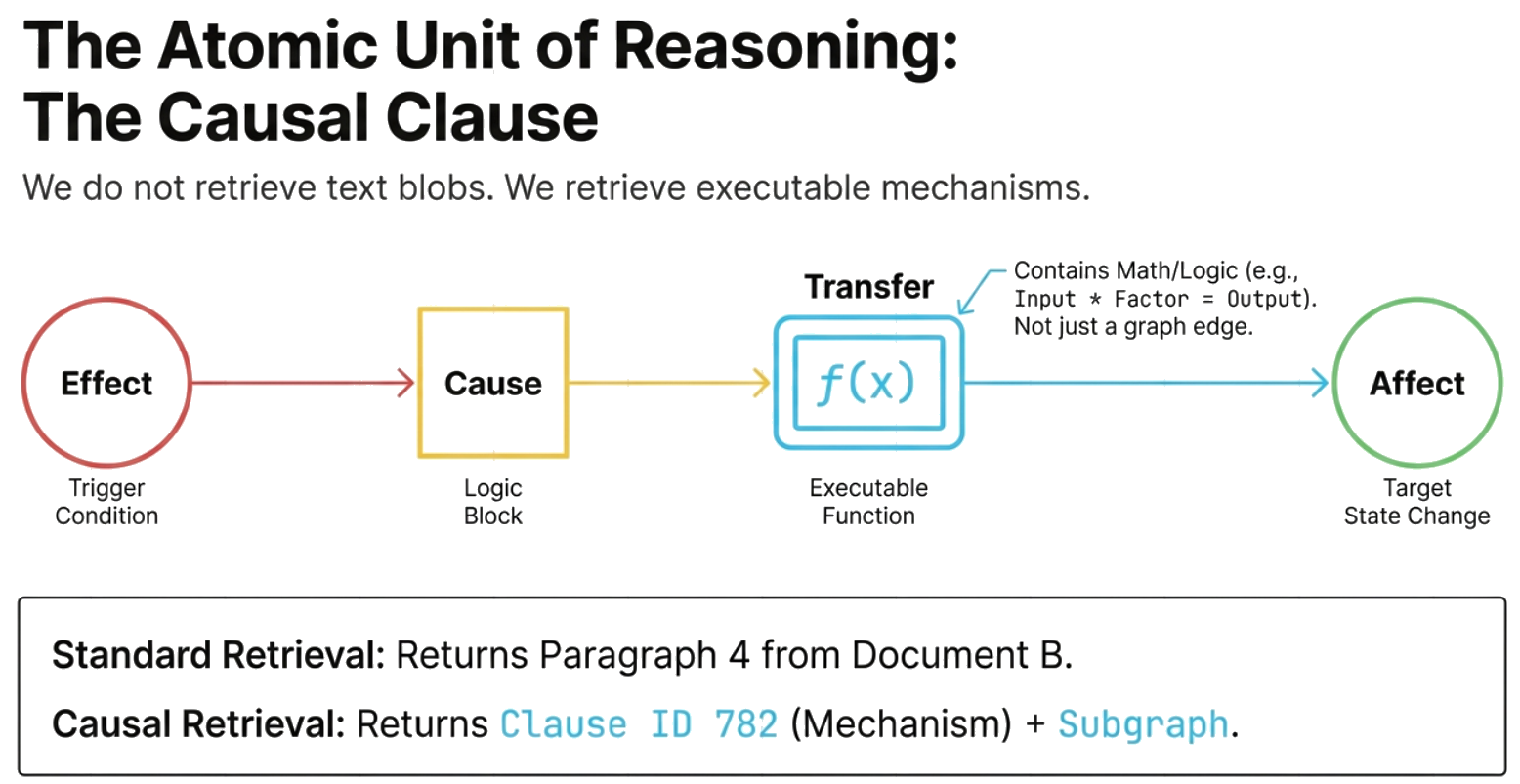
Element
An abstract “thing” in some categorical state. In the domain layer it becomes Source, Subject, Process, Relation, or Object.
Metric
A quantifiable attribute of an Element (a measurable state). Metrics make monitoring, drift detection, and audits concrete.
Cause
An abstract driver of change: rules, conditions, or mechanisms that initiate or constrain transitions (what can change what, and when).
Transfer
A mediator of movement or transformation: how change propagates (energy, information, matter, workflow) through the system.
Edge – Inheritance
Specialization and reuse. It lets a specific object inherit structure/behavior from an abstract parent — keeping schemas consistent as the system grows.
Examples
Apply: apply a learned rule/pattern (Cause) to a concrete case (Element).
Teach: generalize from concrete evidence (Element) into an abstract rule/pattern (Cause).
Edge – Influence
Interaction and dependency. It captures how one object affects another — including triggers, propagation, feedback, and measurable deltas.
Examples
Unit: a Metric defines units for an Element’s measurable attribute.
Affect: a Cause triggers a Transfer (a transformation starts).
Input/Output: Transfers change Metrics; Metric changes can generate Transfers.
Effect: feedback from an Element back into the Causes acting on it.
Rest (diff): represent a difference between two states for a Metric.
Diagram: Meta-Ontology → brGraph
flowchart LR
    linkStyle default stroke:#888,stroke-width:2px,color:#111,font-size:9px;
    classDef e fill:#FFF,stroke:#555,color:#000,font-size:16px,font-weight:bold;
    classDef m fill:#FFF,stroke:#555,color:#000,font-size:10px;
    classDef c fill:#FFF,stroke:#555,color:#000,font-size:10px;
    classDef t fill:#FFF,stroke:#555,color:#000,font-size:8px;

   E["◻ Element - e"]:::e
   M(["○ Metric - m"]):::m
   C[/"▶ Cause - c"/]:::c
   T>"◆ Transfer - t"]:::t
      C -->|"affect - aff"| E
      T -->|"input - in"| M
      T -->|"factor - push"| C
      M -->|"output - out"| T
      E -->|"property - diff"| M
      E -->|"effect - eff"| C
🧱 What this diagram encodes: a deliberately small “physics set” for modeling real domains. Any problem description is reduced to four primitives — Element, Metric, Cause, Transfer — and a finite set of relation types (affect/input/output/factor/property/effect). That reduction is what makes problem-solving tractable: you can always generalize a messy situation into this bounded model.
📏 Why it matters for reasoning: once the vocabulary is finite, the system can keep an explicit accounting of what is known vs what is missing (which Elements/Metrics/Causes/Transfers are undefined, unmeasured, or unsupported). Even if it “knows nothing”, it still knows how many pieces are missing, where the gaps are, and what kind of evidence would fill them.
Diagram: Meta-Semantics → WisdomGraph
flowchart LR
%% Styles (brModel Standard)
classDef i fill:#D3D3D3,stroke-width:0px,color:#000;
classDef p fill:#B3D9FF,stroke-width:0px,color:#000;
classDef r fill:#FFFFB3,stroke-width:0px,color:#000;
classDef o fill:#C1F0C1,stroke-width:0px,color:#000;
classDef s fill:#FFB3B3,stroke-width:0px,color:#000;

            subgraph info["⬛ Information - i"]
                direction LR

                information["⬛ Information - i"]:::i
                energy["🟥 Subjects - s"]:::s
                time["🟦 Processes - p"]:::p
                space["🟨 Relations - r"]:::r
                matter["🟩 Objects - o"]:::o
                information -->|"⬛⬛ context - ii"| information
                information -->|"⬛🟥 subject - is"| energy
                information -->|"⬛🟦 process - ip"| time
                information -->|"⬛🟨 relation - ir"| space
                information -->|"⬛🟩 object - io"| matter
                energy -->|"🟥🟥 role - ss"| energy
                time -->|"🟦🟦 flow - pp"| time
                space -->|"🟨🟨 item - rr"| space
                matter -->|"🟩🟩 portion - oo"| matter
                energy -->|"🟥🟨 sends - sr"| space
                energy -->|"🟩🟥 owns - so"| matter
                space -->|"🟨🟥 receives - rs"| energy
                time -->|"🟦🟥 requires - ps"| energy
                energy -->|"🟥🟦 performs - sp"| time
                matter -->|"🟩🟦 consumes - op"| time
                space -->|"🟨🟦 realizes - rp"| time
                time -->|"🟦🟩 produces - po"| matter
                energy -->|"🟥🟩 controls - so"| matter
                space -->|"🟨🟩 supplies - ro"| matter
                matter -->|"🟩🟨 requests - or"| space
                time -->|"🟦🟨 develops - pr"| space
                energy -->|"🟥⬛ creator - si"| infoNew
                time -->|"🟦⬛ create - pi"| infoNew
                space -->|"🟨⬛ form - ri"| infoNew
                matter -->|"🟩⬛ matter - oi"| infoNew
                infoNew["⬛ New Information - i"]:::i
            end
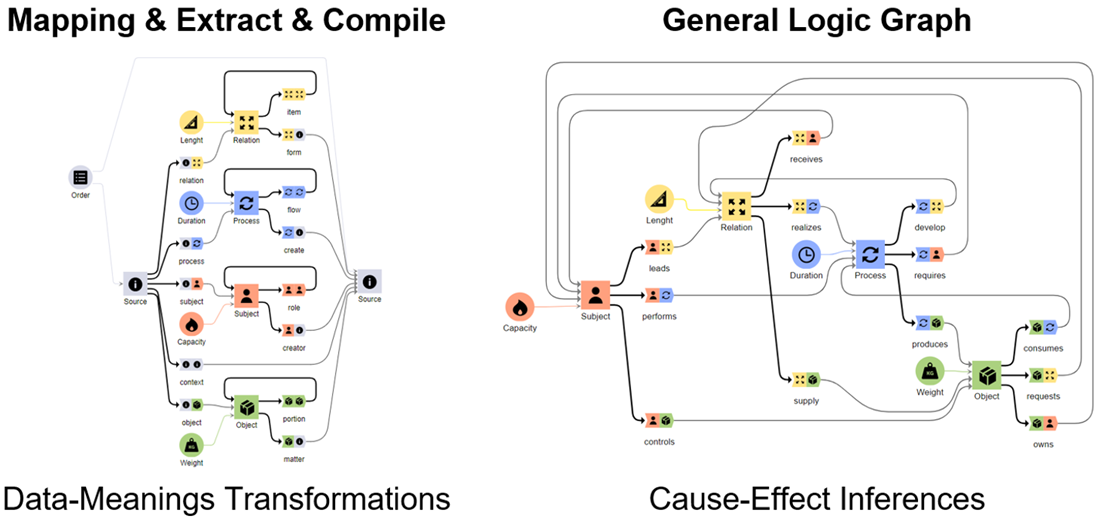
🧭 What this diagram encodes: a domain-facing semantic reduction. Regardless of vocabulary (biomedicine vs finance vs law), domain concepts map to five stable interfaces — Information, Subjects, Processes, Relations, Objects — and a finite set of composable edge types between them.
🧩 Why it makes problem-solving manageable: by limiting the “shape” of a domain to a bounded set of primitives and edges, you prevent unbounded description sprawl. The system can therefore abstract and generalize consistently, while also tracking gaps explicitly: how much semantic structure is already available, how much is missing, and which specific interface (subject/process/relation/object/context) needs new evidence or modeling work.
WisdomGraph: the five domain-facing interfaces
Source
The origin of information and context: discipline, system, dataset, document stream. It anchors provenance and scope.
Subject
An active agent with capacity to act: person, organization, device, service, CPU. Subjects initiate actions and consume constraints.
Process
A sequence over time that transforms inputs into outputs: procedure, workflow, mechanism. Processes explain how outcomes are produced.
Relation
A connection in “space” (not necessarily physical): dependency, interaction, association, pathway. Relations are how systems coordinate.
Object
A thing being moved or transformed: resource, artifact, contract, data, substance, tool. Objects carry “matter” in the abstract sense.
Complexity reduction
These five interfaces are causally composable via a finite set of relation types. That reduction is what makes messy real systems modelable, testable, and governable.
Why it helps: different domains use different nouns, but they rhyme. This gives the memory system stable handles that survive model churn and taxonomy drift.
Why provenance matters
Without provenance, you can’t audit, debug, or falsify.
Provenance turns “an answer” into a decision-grade artifact: it makes claims inspectable and contestable.
Audit
Provenance makes claims auditable: which source supports this, which version, what time window, and under what scope and assumptions.
Debug
Provenance narrows failures fast: was it the data, extraction, constraints, or model behavior — and which specific artifact introduced the error.
Confidence
Provenance shifts confidence from fluency to evidence: trust attaches to source quality, traceability, and constraint satisfaction, not wording.
Falsification
Provenance makes disagreement actionable: which edge is uncertain, what counterevidence would flip it, and what new data would decide.
Reproducibility
Provenance enables reproducibility: re-run extraction, replay traces, and verify outputs across model versions, schema changes, and evolving knowledge.
Governance
Provenance enables permissions, accountability, and lifecycle controls: who asserted what, when it changed, and who approved it.
Diagram: provenance chain (what “grounded” really means)
 flowchart TB
%% Styles (brModel Standard)
classDef i fill:#D3D3D3,stroke-width:0px,color:#000;
classDef p fill:#B3D9FF,stroke-width:0px,color:#000;
classDef r fill:#FFFFB3,stroke-width:0px,color:#000;
classDef o fill:#C1F0C1,stroke-width:0px,color:#000;
classDef s fill:#FFB3B3,stroke-width:0px,color:#000;

I_D(["📄 Document / dataset"]):::i
R_V(["⏱️ Version + timestamp"]):::r
P_X("🧲 Extraction"):::p
R_C(["🧾 Claim (fact) + provenance"]):::r
R_T(["🧭 Trace step (why this edge)"]):::r
P_G("🔒 Constraint validation"):::p
O_O(["✅ Output + audit trail"]):::o
S_B(["🛑 Refuse + violation report"]):::i

I_D --> R_V --> P_X --> R_C --> R_T --> P_G
P_G -->|"Pass"| O_O
P_G -->|"Fail"| S_B

%% Clickable nodes
click P_G "/methodology/constraints/" "Constraints & SHACL"
click R_T "/methodology/brcausalgraphrag/" "brCausalGraphRAG"